

Dear Reader,
The 18th Lok Sabha’s 2026 Monsoon Session of Parliament has just been adjourned sine die. Opposition parties have described this session as an absolute failure. While blaming the government, they forget to mention their own role in the overall performance. Such a display of images, acts, and performance should ache every rational heart in a nation. But do political parties care, irrespective of whether they represent the government or the opposition? All seem complicit in this mayhem of democracy. Do read.
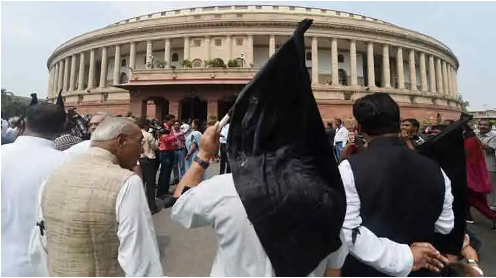
Democracy Disrupted
You can Win Elections, but you cannot rule the Country. The saying explains the state of affairs India is pushed into today through a collaborative effort. Does that mean elections have lost their purpose or value? Or does it mean that the government has to do more to exercise its control over ruling the country? Passing legislation is an act of the democratic process, but implementation of that legislation is an art of ruling in a democratic setup. Why does the government of the day find itself in an immense bind today? Are we a constrained democracy, or is it a mere perception, and are we similar to, if not better than, other major democracies of the world? This piece explores the stability of Indian democracy as an institution. Are we making it better, or are we compromising on its values and tenets?
The monsoon session of the Indian Parliament has just concluded, and it has been accepted as the worst-performing session since 2009. The figures for hours of business are 19% for Lok Sabha and 39% for Rajya Sabha. Only 11or 12 bills passed (Figures are uncertain, as the Parliamentary Affairs Minister has quoted 12, whereas Business Standard quotes 11 bills passed). This session was characterised by drama and action inside and outside the Parliament House. The government business was marred by constant logjam and sloganeering. Amongst the bills which have been passed, only two were seriously discussed on the floor of the house. This guillotine process has been the order of the day, where bills get passed with no discussion. Important bills are stalled without any debate on pretexts that have no relevance to parliamentary proceedings. And the commoner is a mute spectator when their elected representatives see no reason to run the parliament smoothly. Only 11 major bills were cleared; 28 bills were not introduced and were kept pending. 80% of the bills have been passed with no major discussion on the floor of the houses of the parliament.
Only two bills saw structured discussions. All this was because of a logjam and disruptions by the opposition. This monsoon session has been the worst-performing parliamentary session. In terms of cost to the exchequer, one enthusiast on Instagram has calculated that a day of session in parliament costs nine crore Indian Rupees (INR). There have been 13+ major disruptions leading to a waste of about 135 crore to the exchequer. The cost, which the parliamentarians would hardly notice, is borne by the taxpayer. Even if these figures are just notional, they do point to the larger malice that parliamentary sessions are turning into a circus.
Are the constant battles with the opposition normal for Indian democracy or, for that matter, any democracy across the world? How does one judge the vibrancy of a democracy? Is it by allowing protests and dissent, or by the nature of the debate and discussions that take place on the floor of the house when Parliament is in session, on TV every day,y and in the print media? The answer would be all three together. Yet the common perception is that the divide between the government and opposition parties is getting wider and unlikely to be bridged. There is no middle ground left for a flag meeting in military parlance. The visible angst against each other makes it apparent that none is willing to concede any ground to the other, even when it is a matter of national interest.
What is the essence of democracy? A democracy is distinguished from a dictatorship by the nature of governance. Abraham Lincoln, in his famous speech at Gettysburg in November 1863, speaking of democracy, said, “And that the government of the People, by the People, and for the People, shall not perish from the face of the earth”. It is the third part of this definition which is troubling us all: ‘ For the People’. The famous American writer E B White, winner of the Pulitzer Prize and creator of ‘Stuart Little ’, defined ‘Democracy is a recurrent suspicion that half the people are right half the time’. This definition seems to be the closest to reality at the current time. The plight of a commoner defies logic today. He feels impoverished rather than empowered. Should it happen in a ‘Democracy’? Certainly not, and the worst is that he has no grievance-airing mechanism.
The lack of harmony in India’s political class has upset the smooth running of the nation, where the protests, disruptions, and bandhs define everyday life. With thousands of interest groups, each prioritising its own interests over the national interest, the nation faces disruption, most of which is debilitating for the commoner daily. Who is to be blamed? There is no owning up in a modern democracy. The blame always lies with the other party. The opposition parties have blamed the government for the failed monsoon sessions. Yes, they are right, but they missed an important paragraph in that statement: their own role in this failure. The government blames the opposition, and the opposition is very happy to show the government in a poor light even if it is at the cost of the common public good. Who will clear this impasse?
How do other Western Democracies Fare?
How does one judge the functioning of a democracy? To check whether this phenomenon of disruptive parliaments is restricted only to Indian democracy or it has parallels in other democracies too, an analysis of four Western democracies was undertaken. These countries are the UK, with which the Indian parliamentary system is most similar; France, Germany, and the US. It was not easy to compare, as they are not all oranges or all apples. Every system has its own peculiarities, laws and constitutional provisions. Two findings emerged from inspection of various systems. India is the worst in terms of transacting business hours. Disruptions like those in Indian parliamentary sessions seldom occur in Western democracies. The corollary is that the Indian system provides the least amount of scrutiny during the period of legislation. Bills are passed without debates. Second, despite the disruptions, the Indian system is least debilitating for government functioning.
UK has the Westminster style of democracy and is closest to the Indian system. In the UK, bills are debated, and there are heated debates and arguments, yet there are very few walkouts or logjams. The Speaker is empowered to suspend MPs if they behave rudely: for the first offence, five days and then for 20 days. The PM question hour is usually noisy but controlled. In the UK, the opposition usually filibusters, thus talking out a bill rather than walking out on a bill.
In France, the government has the power to pass legislation without the opposition’s consent or debate, as per the constitution’s Article 49.3. Though these are emergency powers, the Macron government has used them 11 times in his second term, starting from June 2022. Opposition parties move thousands of amendments to stall these bills from being put into practice, pass no-confidence motions, and delay implementation.
In the US, the system of Congress: US legislators are most decorous on the floor of the chambers. Yet US law has given a structural veto to the opposition in the Senate for controversial bills. A filibuster leads to the Senate requiring a 60:40 majority for passage. This allows opposition parties to stall any business of the House, and it literally means that, without creating chaos on the floor, the opponents can paralyse the government machinery.
Germany is the most disciplined body of legislators. There is seldom any disturbance. They behave orderly in the parliament. Their legislation hardly ever gets contested as the business of the government is addressed through strong empowered committees. The incentives to topple the government through ‘No Confidence Motions’ are minimised, as the motion has to be accompanied by the election of another candidate who enjoys a majority support in the house. This provision in the Constitution under Article 67 ensures little incentive for destructive politics, as it has to be accompanied by a constructive choice of another consensus candidate.
How does India compare to all these countries? In terms of disruptions, it tops all of these countries. The closest India comes to is the UK, where the floor of the house is more controlled and endless debates and jeering are its best disruptors. Both the speaker and leaders of the house and opposition maintain a strict decorum not to cross into the well, as it so often happens in India. Yet, in terms of disruption, to effectively paralyse government business, the US tops it all. In its constitutional provisions, the Senate can block a bill in perpetuity, as it did in Oct of 2025 for the ‘Funding Bill’. The Senate did not pass it till appropriate amendments were incorporated into the Bill. This refusal led to closure of government for lack of funds for a staggering 43 days. This can never happen in India.
While studying the German system, it came to light that strong committees mainly drove the strength of the government’s work. An empowered committee thoroughly scrutinises a bill before it is introduced in parliament. This reduces friction and brings in consensus. So why can’t the same system be adopted in the Indian Parliament? This mechanism has been the demand of the opposition every time a controversial bill is introduced in Parliament, like the GST bill, the Land Reform bill, or currently the Delimitation Bill. The NDA government, based on statistics, does not prefer consensus through review by respective parliamentary committees. Many of these are chaired by opposition parties’ leaders, and the government fears that important issues, if left to such committees, would most likely not be recommended for legislation or, at best, would face much delay. Thus, to fast-track, the government introduces them as bills, hoping to pass them through Parliament, especially in the Lok Sabha, where the present NDA government has the numbers to pass the legislation. Their Waterloo is the Rajya Sabha, where they depend on other smaller parties for issue-based support.
Is the government right about not depending upon parliamentary committees for discussion in light of the growing menace of logjams and walkouts? It is hard to pronounce judgement, as it is not a constitutional must, and the ruling NDA government wants to introduce reforms that were introduced by the UPA government, but never seriously pursued, like the Women’s Reservation Bill and the FCRA. Yet soon the government will have to find a way to reach some consensus on how to conduct business in the parliamentary sessions; otherwise, this model is best suited for the opposition parties to blame the government for their inability to conduct a successful session.
Conclusion
Any government is worth its being in power if it makes the lives of its people safe and comfortable. The current government has been in power for nearly two and a half terms. By now, they should have got a hold of their act and got a grip on many subjects like Law and Order, Education, Reservation, Corruption, Police Reforms (Though Police is a state subject, yet they are long overdue), devolution of financial grants to the state in light of GST, etc. Yet the government is still grappling with ordinary day-to-day issues leading to discontent and disruptions. The LOP (Leader of the Opposition) has adequately shown that mockery can disrupt the government’s business and image. The Jantar Mantar protests were only the beginning of a larger dissatisfaction that is brewing in society. The author does not believe it has to do with the current government or state governments. It’s the lack of empathy among decision-makers and political parties, who care very little about people and very much more about personal gains and rewards. A typical syndrome of the rich becoming rich at the cost of the poor. Democracy is for the people, and politicians and political parties must realise that the people do not go into the background or underground once elections are over, till the next elections. This oversight can be disastrous for them in the near future. Democracy is the best type of governing system, till it fulfils the criteria: Of the people, by the people and most importantly, for the people.
Minal thank you for your comment . The state of affairs is grim. It pains an honest and patriotic Indian to see the political circus which is on display on every platform today. I feel sad but I wish I could paint a more happy picture. There isn’t one .
Very informative and the comparisons alone are worth keeping for reference. And this is as wise as it is true: "Democracy is for the people, and politicians and political parties must realise that the people do not go into the background or underground once elections are over, till the next elections."